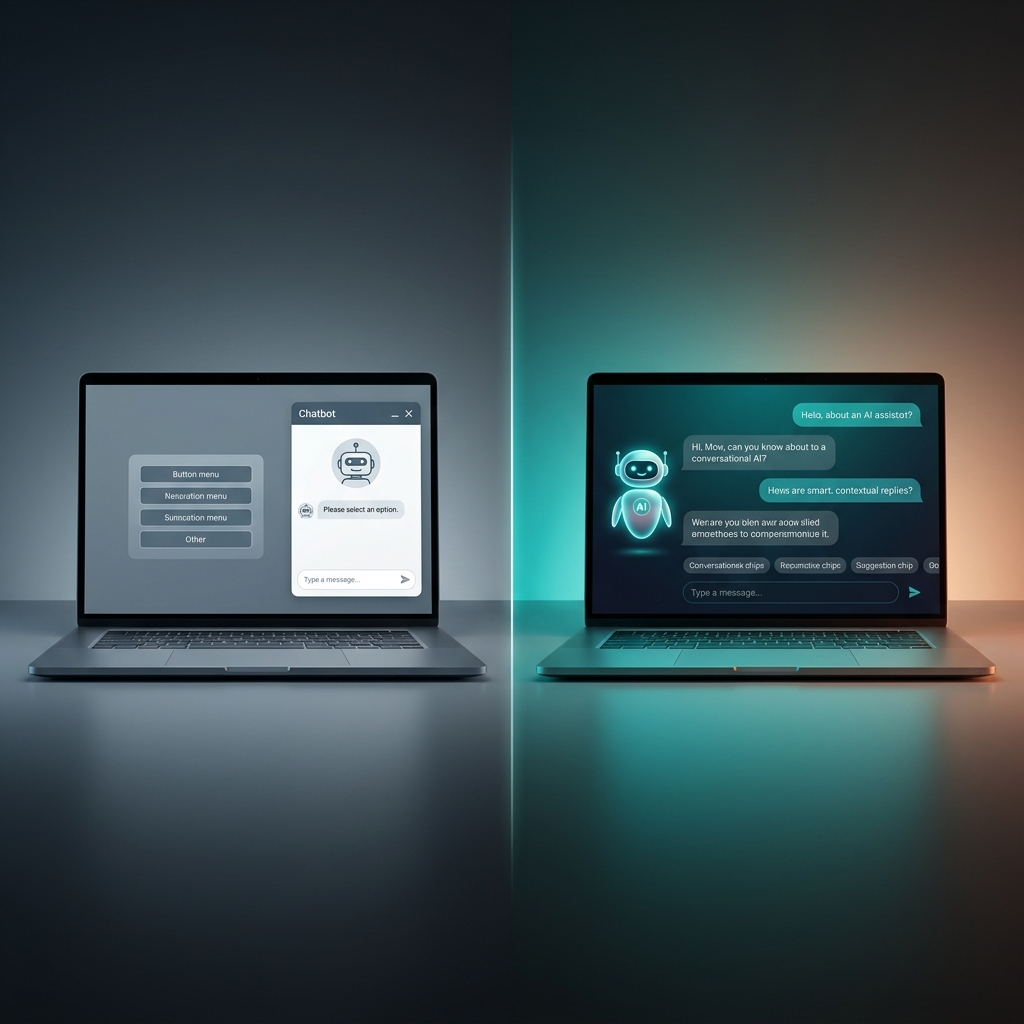
Chatbot vs. Conversational AI: Which One Does Your Business Actually Need?
You message a business. The reply is instant — but it keeps looping you through the same three options and can't answer your actual question. Sound familiar? That's a traditional chatbot.
Now imagine a different experience: you type a messy, half-finished sentence and the assistant still understands you, remembers what you asked five minutes ago, and books an appointment on the spot. That's Conversational AI.
Both are called "chatbots" — but they couldn't be more different. This guide breaks down what separates them, when each one makes sense, and why the smartest businesses are deploying Conversational AI on WhatsApp.
Think: Vending Machine vs. Concierge
Traditional Chatbot — The Vending Machine
A chatbot follows a pre-written script — a decision tree of "if-then" rules. Press button A1, get snack A1. Ask anything outside the script and it breaks. It can't remember what you said two messages ago, struggles with typos, and lives on a single website widget.
Conversational AI — The Concierge
Conversational AI uses Natural Language Processing and Machine Learning to understand intent, not just keywords. It holds context across an entire conversation, handles slang and complex follow-ups, and learns from your existing data — no manual FAQ entry required.
The Architecture: State-Machines vs. Agentic Workflows
State-Machine Chatbots
Under the hood, a traditional chatbot relies on a finite-state machine architecture. This means the system can only move between pre-defined states (e.g., State 1: Ask for Order ID ➡️ State 2: Display Shipping Status). If a user provides an unexpected input, the state machine fails to map it and throws an error or loops the user back to the start.
Agentic Workflows
Modern Conversational AI thrives on Agentic Workflows powered by Large Language Models (LLMs). Instead of fixed paths, the AI agent dynamically determines the next best step. Using tool-calling (like function execution), an agent can autonomously query a database, perform multiple distinct actions, and synthesize a response—all within a single conversational turn. It doesn't break when unexpected data occurs; it reasons around it.
Multimodal Capabilities
Today's advanced systems go beyond text. By incorporating Multimodal LLMs, conversational AI can process images, voice notes, and documents simultaneously. A user can send a photo of a broken part, and the AI can cross-reference it with technical manuals to instantly diagnose the issue and order a replacement.
Side-by-Side Comparison
| Feature | Traditional Chatbot | Conversational AI |
|---|---|---|
| Logic | Rigid "If-Then" rules | Neural-network reasoning |
| Memory | None — each message is isolated | Full conversation context |
| Language | Breaks on typos or slang | Handles natural, messy language |
| Setup | Manual entry of every FAQ | Learns from your docs & data |
| Channels | Website widget only | WhatsApp, Telegram, Web & more |
| Actions | Replies with text only | Books, bills, escalates & integrates |
Why the Difference Matters
A chatbot talks. Conversational AI acts. Here's what that looks like in practice:
It Handles Real Conversations
Humans don't talk in straight lines — we change our minds mid-sentence, use metaphors, and jump between topics. Conversational AI handles "Actually, before we book that, what was the price of the other option again?" gracefully. A traditional chatbot simply breaks.
It Integrates With Your Systems
Instead of just displaying information, Conversational AI connects to your CRM, inventory, or ERP. It doesn't just say "your order is on the way" — it checks the live tracking, updates the delivery ETA, and offers a discount code for the delay, all within the same chat.
It Delivers Real ROI
Businesses that move from basic bots to Conversational AI report 60%+ reduction in support costs and 3× faster response times. Because the AI handles routine queries end-to-end, your team focuses on the work that actually needs a human.
The Best Channel to Deploy It? WhatsApp.
Conversational AI is the brain. WhatsApp is the channel that puts it in your customer's pocket. With a 98% message open rate (vs. ~20% for email), WhatsApp automation meets customers where they already are.
| Use Case | What Happens on WhatsApp |
|---|---|
| Lead Capture | AI qualifies prospects with smart questions & routes hot leads to your sales team |
| 24/7 Support | FAQs, order tracking, returns — resolved instantly without human intervention |
| Reminders | Appointment & order alerts that reduce no-shows by 40%+ |
| Campaigns | Targeted promotions & re-engagement to segmented audiences — fully compliant |
Through the WhatsApp Business API, your AI handles thousands of conversations simultaneously and plugs into your CRM, ERP, and payment systems — turning WhatsApp from a messaging app into a full customer operations channel.
So, Which One Do You Need?
If you only need to display opening hours, a basic chatbot is fine. But if you want to automate sales conversations, provide around-the-clock expert support, capture and qualify leads automatically, and reduce your team's manual workload — you need Conversational AI on WhatsApp.
"Your customers are already on WhatsApp. The question is — are you automating the conversation, or losing it?"
Ready to see what Conversational AI on WhatsApp can do for your business? Let's talk.
The barrier to entry for custom AI has never been lower. Whether you are looking to automate internal operations, streamline your fleet, or build a customer-facing AI product, let's talk.
Contact Us Today